
Urban Sketching in Your Travel Journal: A Guide to City Perspectives and Lights
There is a specific kind of magic found in the organized chaos of a city. Whether it’s the sun-drenched, dusty intersections of Tamale, the neon-slicked streets of Tokyo, or the grand, shadow-heavy boulevards of Paris, urban environments offer a sensory feast that a camera often fails to fully digest.
A photo captures a millisecond; a sketch captures a conversation.
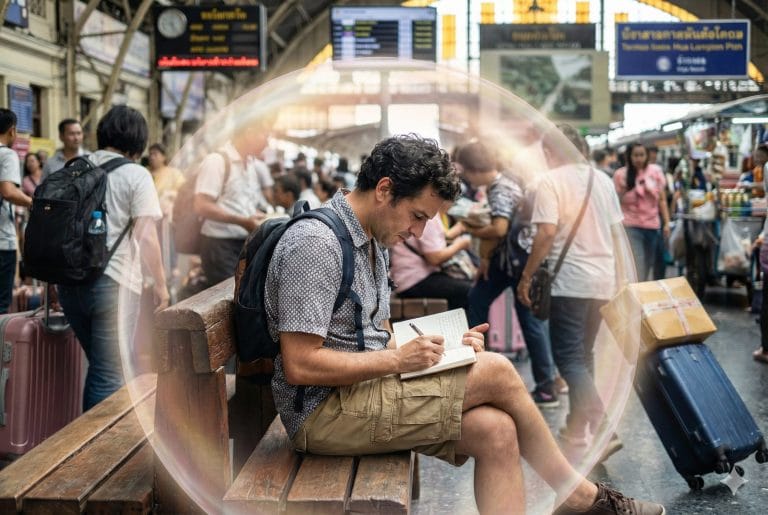
Urban sketching—the act of drawing on location in the cities where we live or travel—is one of the most immersive forms of travel journaling. It forces you to sit still while the world moves around you. It demands that you notice the way a telephone wire bisects a colonial-era roof or how the afternoon sun turns a grimy alley into a cathedral of gold.
If you’ve ever felt intimidated by the “technical” side of drawing cities—the daunting angles and shifting shadows—this guide is for you. Here is how to use your journal to decode perspective and light, turning an overwhelming cityscape into a manageable, beautiful memory.
The Power of Visual Journaling
We often think of travel journaling as a purely linguistic exercise—filling pages with the “who, what, and where.” But adding a visual element shifts your brain from “recording” to “observing.”
When you sketch, you aren’t just looking at a building; you are understanding how it stands. You are noticing the rhythm of the windows and the specific hue of the brickwork. Even if your “sketch” is just a collection of shaky lines and basic shapes, the act of drawing anchors that city in your mind with far more permanence than a digital snapshot ever could.
Learn more about our Quick-Fill Travel Journals for ANY Destination. Options for All Ages available.

Mastering Perspective: Finding the “Skeleton” of the City
The biggest hurdle in urban sketching is perspective. We see a street receding into the distance and our brains panic at the complex geometry. To conquer this, you need to look for the “skeleton” of the scene.
1. Identify the Horizon Line
The horizon line is always at your eye level. Everything above it angles down toward it; everything below it angles up.
- Journaling Prompt: Draw a single horizontal line across your page. Before you draw a single building, mark where your eyes meet the distance. Everything else is just a series of connecting dots.
2. The “Triangle” Method
Most city streets can be simplified into a large triangle. The base is the street in front of you, and the sides are the rows of buildings leaning toward a single “vanishing point” in the distance.
- Journaling Prompt: Find the vanishing point—the spot where the road seems to disappear. Sketch a faint ‘V’ shape from that point. Use this ‘V’ as the guide for the tops and bottoms of the buildings.


Chasing the Glow: Capturing Light and Shadow
Light is what gives a city its soul. The same street can look clinical at noon, romantic at 5:00 PM, and mysterious at midnight. To capture light in your travel journal, you have to stop looking at objects and start looking at shapes of value.
3. Squint to See the Shapes
When we look at a building, we see windows, doors, and signs. When we squint, we see only dark and light shapes.
- Journaling Prompt: Squint at your subject until the details blur. Where is the darkest shadow? Where is the brightest highlight? Draw only the shapes of the shadows first. Let the light take care of itself.
4. The “Temperature” of the City
Light has a temperature. Morning light is often cool and blue; the “Golden Hour” before sunset is warm and orange.
- Journaling Prompt: Instead of coloring the whole scene, note the direction of the sun. Write a single sentence in the margin of your sketch about the quality of the light. (e.g., ‘The sun hit the west-facing walls like a spotlight, leaving the street in deep navy shadows.’)
The “Quick-Fill” Methodology for the On-the-Go Artist
Let’s be honest: travel is fast. You don’t always have two hours to set up an easel and paint a watercolor masterpiece while your travel companions are waiting to find the next street food stall. Sometimes, you only have ten minutes while waiting for a bus or a coffee.
This is where a Quick-Fill mindset becomes essential for the creative explorer.
You don’t need a completed, gallery-ready painting to have a successful journaling session. In fact, some of the most evocative travel journals are those that utilize a “Quick-Fill” approach—mixing small, five-minute sketches with structured data.
If you are using a system like our Quick-Fill Travel Journals, you can use the designated sections for weather, location, and daily highlights to “ground” the logistics of your day. This frees up your creative energy to focus on just one small visual detail—perhaps just the arch of a doorway or the silhouette of a skyline. By having the “framework” of your journal entry already handled by the structured prompts, your sketch doesn’t have to carry the burden of the entire memory. It can just be a beautiful, quick impression.
Integrating Words and Art: The Narrative Sketch
A sketch is even more powerful when paired with specific, targeted journaling prompts. This creates a “multimodal” memory that engages both sides of your brain.
- Prompt: The Social Layer
- While you sketch a building, listen to the sounds around you. Write three snippets of overheard conversation into the negative space of your drawing.
- Prompt: The Tactile Detail
- Sketch one small, close-up texture you see in the city—the peeling paint on a shutter, the pattern of the cobblestones, or the weave of a local basket. Write one word describing how that texture would feel.
- Prompt: The “Why” of the Scene
- Below your sketch, answer this: Why did I choose to stop and draw this specific spot? What about the perspective or the light made me feel ‘present’?
Pro-Tips for Sketching in the Wild
- Embrace the “Mistake”: Cities are messy. Your lines should be, too. A shaky line often captures the “vibe” of a bustling street better than a perfectly straight one.
- Start Small: Don’t try to draw the entire skyline. Start with one window, one lamppost, or one person sitting at a table.
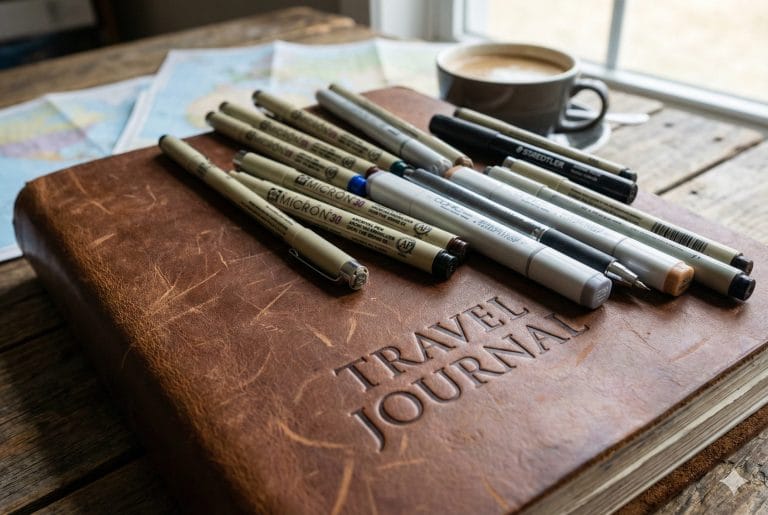
- Use a Waterproof Pen: If you decide to add a splash of color later with a travel watercolor set, you won’t want your perspective lines to smudge!
Final Thoughts
Urban sketching is an act of devotion to the places we visit. It is a way of saying, “I saw this. I felt the sun on this wall. I understood the shape of this street.”
By using your travel journal to capture the perspective and light of the city, you aren’t just making art; you are making a home for your memories. You are slowing down the clock in a world that is always telling you to hurry up.
So, the next time you find yourself in a new city, don’t just reach for your phone. Reach for your pen. Find the vanishing point, squint for the shadows, and let the city reveal its skeleton to you, one line at a time.
Ready to streamline your storytelling and make room for more creativity? Explore our collection of Quick-Fill Travel Journals at The Explorer’s Nook—designed to handle the logistics so you can focus on the beauty.
Why Choose a “Quick-Fill” Journal?
Let’s be honest: traditional journaling can feel like a chore. We’ve all started a trip with a beautiful blank notebook, only to abandon it by day three because we were too busy actually traveling.
The Explorer’s Nook was born from the idea that you shouldn’t have to choose between living the moment and logging it. Our Quick-Fill system is designed to be:
- Low Pressure: No more staring at a blank page. We use checkboxes, simple prompts, and “Best of” lists to help you capture the magic in five minutes or less.
- Dopamine-Friendly: Designed for both tired travelers and those with neurospicy/ADHD brains. The layouts provide enough structure to keep you focused without the overwhelm of long-form writing.
- Memory-First: We focus on the sensory details—the smells, the weird snacks, and the “you had to be there” moments—so you can look back years from now and feel like you’re right back in the adventure.
- Built for Action: Whether you’re bouncing in a Land Rover on a dusty safari or navigating a busy city break, these journals are meant to be used on the go, not just at a desk.
Record the memory. Get back to the adventure.
FAQ
Urban sketching is the practice of drawing on location in cities, towns, or villages. It focuses on capturing the reality of the environment as the artist sees it in the moment, often including architecture, people, and the play of light and shadow.
Start by simplifying complex scenes into basic shapes. Use a “Quick-Fill” approach by focusing on small details rather than entire landscapes. Pair your sketches with written prompts about the sensory details of the environment to create a richer memory.
No. Visual journaling is about observation, not perfection. Simple sketches, diagrams, and “value shapes” are effective ways to anchor memories and improve situational awareness, regardless of your technical skill level.