
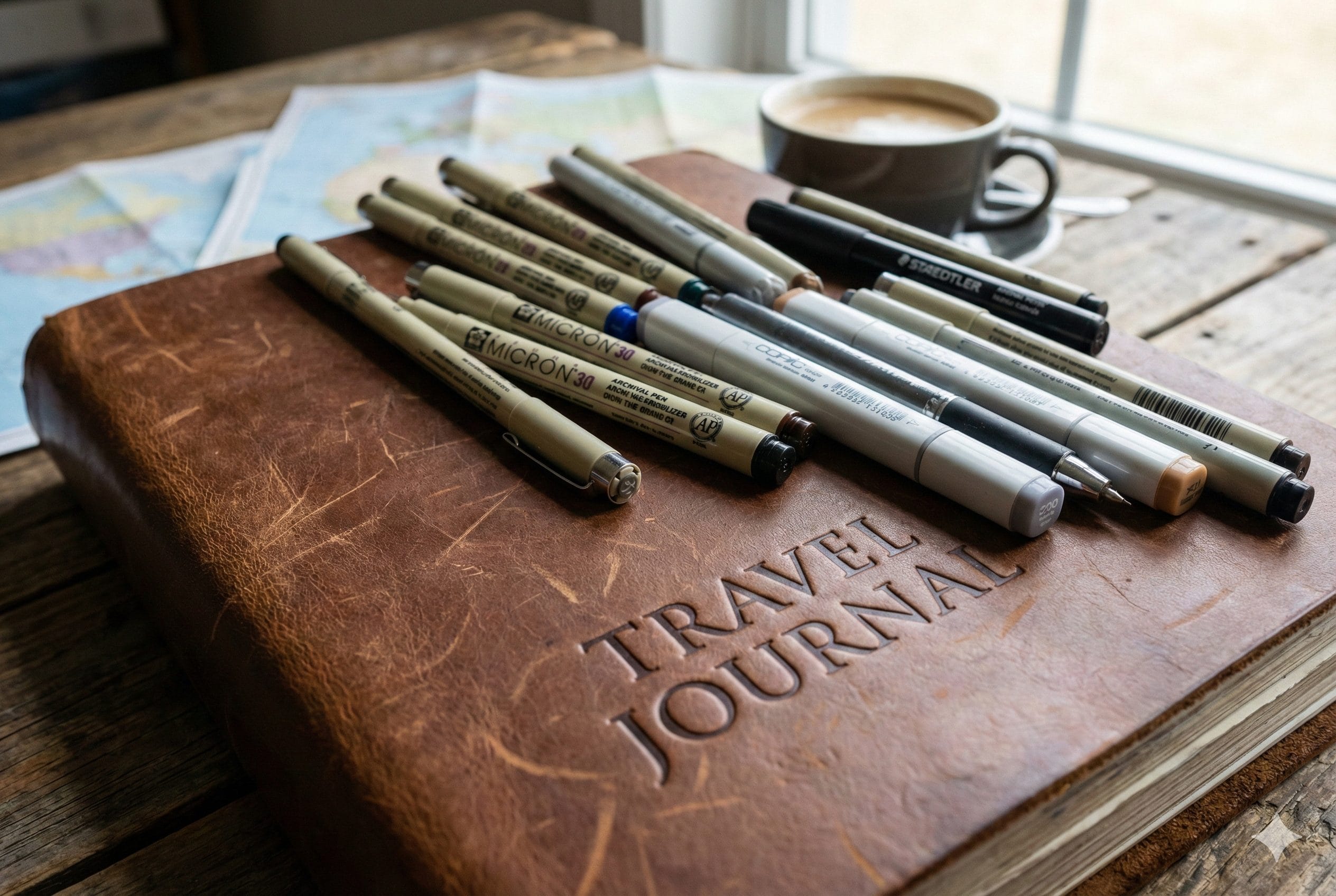
Pen Testing: The Best Archival Pens That Won’t Bleed on Printable Journal Paper
If you’ve embraced the genius of the printable travel journal, you know the freedom of customized templates and lightweight organization. But your success hinges on one crucial detail: the pen.
Using the wrong ink can turn your perfect, custom-printed pages into a messy disaster. Printable paper, often being thinner or more porous than expensive specialty notebook paper, requires an ink that is fast-drying, fine-tipped, and, critically, archival—meaning it won’t fade or damage your memories over time.
We know that discerning travelers are searching for best pens for thin paper, archival quality travel pens, and pens that won’t bleed through printable templates. Here is your definitive guide to selecting the best pen arsenal for your printable journal.
1. 🔬 The Bleed Test: Understanding Printable Paper Challenges
Why is printing paper so sensitive? It lacks the heavy coatings and sizing agents found in premium notebooks, making it prone to bleed-through.
A. The Enemy: Dye-Based Ink
- Avoid: Most standard markers, low-cost rollerballs, and many vibrant fountain pen inks use dye-based formulas. Dyes are absorbed into the paper fibers like water, leading to severe bleeding and ghosting (the shadow of the writing visible on the other side of the page).
B. The Solution: Pigment-Based Ink
- Look For: Pens labeled as “Pigment,” “Archival,” or “Pigma.” Pigment particles are microscopic solids that sit on top of the paper fibers rather than soaking in. This creates a sharp line with minimal bleed.
Check out our Quick-Fill Travel Journals on Etsy:


Quick-FIll Travel Journal for ANY Destination
The travel journal for explorers who want to remember everything, but would rather be living the adventure than staring at a blank page.

2. 👑 The Archival Heroes: Top 3 Pen Types
These three pen categories offer the best combination of fine points, pigment ink, and durability for printable paper (which often includes our Quick-Fill and specialized templates).
A. Fineliners (The Gold Standard)
- Why They Win: Fineliners are the safest bet. Their tips are precise (ideal for writing in the small boxes of a Quick-Fill log), and the ink is almost always a stable, quick-drying pigment.
- Best Uses: Capturing detailed data in small fields (like your New Foods I’ve Tried Log), drawing borders, and primary writing.
- Recommended Tip Size: Stick to 0.3mm to 0.5mm. Anything thicker increases the chance of bleeding.
B. Archival Gel Pens (The Smooth Operator)
- Why They Win: These pens offer a smoother, more fluid writing experience than fineliners, making prose enjoyable. Many use high-density gel ink that dries quickly, provided the ink is pigment-based.
- Best Uses: Longer reflective entries, signing documents, and quick daily highlights.
- Crucial Check: Must be labeled “Archival,” “Permanent,” or “Waterproof.” Standard office gel pens are notorious for bleeding and smudging before they dry.
C. Ballpoint Pens (The Rugged Backup)
- Why They Win: While less elegant, a quality ballpoint pen with oil-based ink is the most waterproof and bleed-proof option, as the ink is thick and sits right on the surface.
- Best Uses: Journaling in damp climates (like monsoon season in Southeast Asia) or for logging crucial data in a rush.
- Minimalist Hack: Carry a single, high-quality, retractable ballpoint pen as your “must-not-fail” backup.


3. 🛡️ The Pre-Trip Test: Your Essential Protocol
Never trust a pen brand new out of the package. Test it before your trip to avoid ruining a precious entry.
- The Sample Page Test: Print out a single, spare Quick-Fill Daily Log page. On a quiet section of the page, write a few words using the pen. Wait 30 seconds, then check the reverse side. If you see any wet ink or visible pooling, the pen is too wet for your paper.
- The Smudge Test: Once the sample text is dry (wait 60 seconds), run your finger lightly across the ink. If it smudges, it will smudge in humid environments or when you quickly close your journal. A smudging pen fails the travel test.
- The Environmental Check: If you are traveling to a high-humidity area (like Coastal West Africa or Southeast Asia), take the pen into a steamy bathroom and see if the ink starts to wick or spread on the page.
By choosing pigment-based, fine-tipped, archival pens, you ensure that the cost-saving and organizational benefits of your printable journal templates are fully realized, leaving you with clean, legible, and everlasting memories.
Oh, and also consider upgrading the paper you print your printable travel journal on. That will make these pen upgrades even more effective.


