
Travel Journaling Prompts for Assessing Safety in New Places
Arriving in a new neighborhood is one of the most exhilarating moments of any trip. Whether it’s the sun-drenched alleys of a Mediterranean coastal town, a high-octane district in a Southeast Asian metropolis, or a quiet residential pocket of a West African city, that first walk-around is when a destination starts to feel “real.”
However, beneath the excitement of finding the best local coffee shop or the nearest market lies a fundamental travel necessity: situational awareness. We often talk about travel journaling as a way to capture the beauty of a sunset or the flavors of a new dish, but a journal is also one of the most effective tools for personal safety.
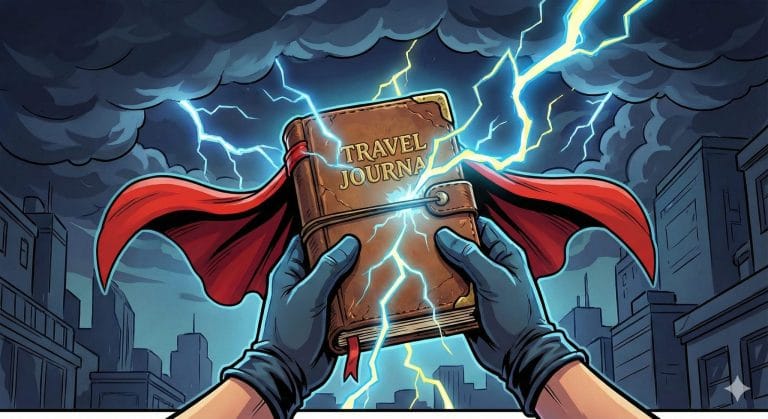
By conducting a “Security Audit” through your journaling practice, you move beyond vague “gut feelings” and start documenting objective observations. This process doesn’t just make you safer; it gives you the confidence to explore more deeply because you actually understand the environment you’re moving through.
Learn more about our Quick-Fill Travel Journals for ANY Destination. Options for All Ages available.

The Journal as a Tool for Situational Awareness
In a world dominated by digital maps and safety apps, the act of slowing down to write in a physical journal might seem counterintuitive. But digital tools often keep our eyes glued to a screen, which is the opposite of being aware of our surroundings.
When you use your travel journal to conduct a security audit, you are training your brain to notice patterns. You start to see the difference between a neighborhood that is simply “lively” and one that is “unpredictable.” You begin to identify safe havens and exit routes before you actually need them.
Journaling forces a level of observation that an app cannot provide. It turns you from a passive tourist into an active explorer who is tuned in to the local frequency.
The “First 24 Hours” Audit: Physical Environment Prompts
The best time to perform a security audit is during your first full day in a new location. Use your journal to answer these specific prompts as you walk through your immediate neighborhood.
1. Lighting and Visibility
- The Prompt: Identify three paths from the nearest transit hub to my accommodation. Which one has the most consistent street lighting after 7:00 PM?
- Why it matters: Seeing a route in the daylight is different from seeing it at night. Documenting the “brightest” route helps you make better decisions when returning home after dinner.
2. The “Safe Haven” Map
- The Prompt: Between my front door and the main road, where are the “always open” businesses? (e.g., 24-hour pharmacies, well-lit hotels with security, or busy convenience stores).
- Why it matters: If you ever feel followed or uncomfortable, knowing exactly where a “safe” door is located—and having it logged in your mind via your journal—can prevent panic.
3. Physical Obstacles and Dead Zones
- The Prompt: Are there specific blocks that feel “empty” or have high walls and limited exits?
- Why it matters: “Dead zones” are areas with low natural surveillance. Noting these in your journal allows you to plan alternate routes that stay in more populated, visible areas.
Check out our range of Safari Quick-Fill Journals for All Ages with Animal Spotting Logs and other Safari features.

Decoding the Social Landscape: Human Element Prompts
Security isn’t just about streetlights; it’s about the “vibe” or social fabric of a place. Use these prompts to decode the human element of your new neighborhood.
4. The Local Rhythm
- The Prompt: What is the “shift change” in this neighborhood? When do the families go inside, and when does the nightlife crowd arrive?
- Why it matters: Every neighborhood has a rhythm. A street that is perfectly safe for a solo walk at 2:00 PM might feel entirely different at 10:00 PM. Understanding this transition helps you time your explorations.
5. Interaction Patterns
- The Prompt: How do locals interact with one another? Is there a lot of shouting, or is it quiet? Do people look each other in the eye?
- Why it matters: Establishing a “baseline” for normal behavior in a new culture is vital. When you know what “normal” looks and sounds like, you can more easily spot an anomaly that might signal a potential risk.
The Logistics Log: Hard Data for Emergencies
Every security audit should include a page dedicated to the “boring but essential” facts. Don’t rely on your phone for these; write them in the back of your journal.
- Local Emergency Numbers: (They aren’t 911 everywhere!)
- The Nearest Hospital: Not just any clinic, but the one with an 24-hour ER.
- The Address of Your Accommodation in the Local Language: If you need to jump in a taxi quickly, being able to show the written address is faster than struggling with a translation app.
The “Quick-Fill” Approach to Safety
We often hear from travelers who say, “I want to stay safe, but I don’t want my journal to turn into a police report.” We completely agree. The goal of travel journaling is still joy and discovery. If you spend your entire trip obsessing over “risk logs,” you’ll miss the magic of being there.
This is where the Quick-Fill philosophy becomes a game-changer for safety. By using a structured system—like our Quick-Fill Travel Journals—you don’t have to write essays about neighborhood watch. You can use pre-formatted sections to quickly check off your security observations.
A “Quick-Fill” audit might look like a simple list of three bullet points at the bottom of your daily entry:
- Route A is better lit.
- Market opens at 6:00 AM (Safe/Busy).
- Pharmacy on the corner is 24/7.
It takes thirty seconds, but it cements that information in your brain. It allows you to maintain your “security audit” without letting it overshadow the fun of the journey. When the formatting is already done for you, staying safe becomes a seamless part of your daily ritual rather than a chore.
Turning Your Audit into Intuition
The final stage of a security audit is the “Gut Check.” After you’ve logged the lights, the shops, and the social vibes, take a moment to reflect.
- The Prompt: On a scale of 1-10, how “at home” do I feel walking here alone? What is one specific thing that would move that number up by two points?
Maybe the answer is “walking with a friend” or “leaving the expensive camera in the safe.” By naming the anxiety and documenting it in your journal, you take the power away from the fear. You aren’t just “feeling” nervous; you are identifying a specific variable that you can control.


Final Thoughts
A security audit isn’t about being paranoid; it’s about being a professional-level traveler. When you take the time to use your journal to assess and log your surroundings, you are giving yourself the greatest gift an explorer can have: peace of mind.
With your safe routes identified, your emergency numbers logged, and your “Quick-Fill” observations noted, you can stop looking over your shoulder and start looking at the incredible world in front of you.
Looking for a way to stay organized and aware without the stress of a blank page? Explore our range of Quick-Fill Travel Journals at The Explorer’s Nook—designed to help you track your logistics, your memories, and your safety all in one place.