
Travel Money Management: Journal Prompts for Processing the Stress of Currency Exchange and Fees
The romanticized version of travel rarely includes a calculator. We dream of bargaining for textiles in a bustling market, sipping espresso in a quiet plaza, or catching a shared taxi to a remote waterfall. But the reality of executing those dreams often involves standing in front of a foreign ATM, sweating over conversion rates, and wondering if that “3% foreign transaction fee” is going to break the budget.
Money management abroad is one of the most common, yet least discussed, sources of travel anxiety. Whether you are crossing overland borders in West Africa and suddenly juggling Cedis and CFA francs, or trying to mentally convert Thai Baht while a line of people waits behind you, “math fatigue” is real. It can leave you feeling vulnerable, frustrated, and disconnected from the joy of your trip.
While spreadsheets and budgeting apps are great for the numbers, they don’t help with the emotions of spending. This is where your travel journal becomes a vital financial tool. By using targeted journal prompts, you can process the stress of currency exchange, reframe your relationship with travel fees, and get back to enjoying your adventure.
The Hidden Emotional Toll of Travel Finance
Why does money feel so much more stressful abroad? It usually boils down to three factors:
- Cognitive Overload: Your brain is already working overtime to process new languages, navigate unfamiliar streets, and adapt to different climates. Forcing it to constantly multiply by 0.08 or divide by 134 adds significant cognitive friction.
- The “Scam” Paranoia: When you don’t fully understand a currency, there is a lingering fear that you are overpaying or being taken advantage of by money changers.
- The “Death by a Thousand Fees” Feeling: Watching $5 ATM fees and 3% conversion charges stack up can trigger a scarcity mindset, making you feel like your travel funds are leaking.
To prevent these feelings from overshadowing your trip, you need a space to vent, process, and reframe. Your travel journal is the perfect judgment-free zone.
Learn more about our Quick-Fill Travel Journals for ANY Destination. Options for All Ages available.

Journal Prompts for Processing Financial Travel Stress
When you feel budget anxiety creeping in after a confusing day of currency exchanges, sit down in a quiet café, pull out your travel journal, and work through these prompts.
1. The “Money Anxiety” Brain Dump
When you are overwhelmed, the best first step is to get the worry out of your head and onto paper.
- Prompt: What specific financial transaction stressed me out today? Was it the math, the interaction, or the fear of the cost?
- Exercise: Write down the exact scenario. For example: “I felt panicked at the border crossing because I didn’t know the going rate for the local currency, and I felt rushed by the money changers.” Naming the exact trigger reduces its emotional power.
2. Reframing the “Travel Tax”
It is easy to get angry about ATM fees, visa costs, and poor exchange rates. But holding onto that anger ruins your day.
- Prompt: How can I mentally reframe today’s unexpected fees as the “cost of admission” for this experience?
- Exercise: Instead of viewing a $6 ATM fee as “stolen money,” write about it as a convenience tax. “I paid $6 today for the privilege of accessing my home bank account from a machine 5,000 miles away. That $6 allowed me to buy dinner tonight.”
3. The Value vs. Cost Check-In
When doing mental gymnastics with exchange rates, we often hyper-focus on the cost of things rather than their value.
- Prompt: What is one thing I spent money on today that brought me absolute joy, regardless of the exchange rate?
- Exercise: Shift your focus from the math to the memory. Did that slightly-overpriced gelato overlook a stunning cathedral? Did paying a bit extra for a direct bus save you four hours of bumpy roads? Write down the return on investment for your happiness.
Check out our range of Safari Quick-Fill Journals for All Ages with Animal Spotting Logs and other Safari features.

Logistical Journaling: The Money Management Layout
In addition to emotional processing, your journal should also serve as a hard-data anchor. When your brain is tired, having a written “cheat sheet” for currency conversion is a lifesaver.
Create a Currency Cheat Sheet on the inside cover of your journal. Do the math once, write it down, and refer to it daily so you don’t have to calculate in your head.
Example Cheat Sheet (Update when you change countries):
- Local Currency: _________
- $1 USD = _________
- $5 USD = _________ (The cost of a basic meal/coffee)
- $20 USD = ________ (The cost of a standard bus ticket/hostel)
- $50 USD = ________ (The cost of an excursion/nice dinner)
- My ATM/Card Limit per withdrawal is: ________
Having these benchmark numbers written down gives you immediate confidence when bargaining at a market or reviewing a restaurant menu.
The Quick-Fill Approach to Financial Logs
At the end of a long day of exploring, the idea of doing more math or designing a complex budget grid in your journal sounds exhausting. When you are tired, a blank page can feel more like a chore than a comfort.
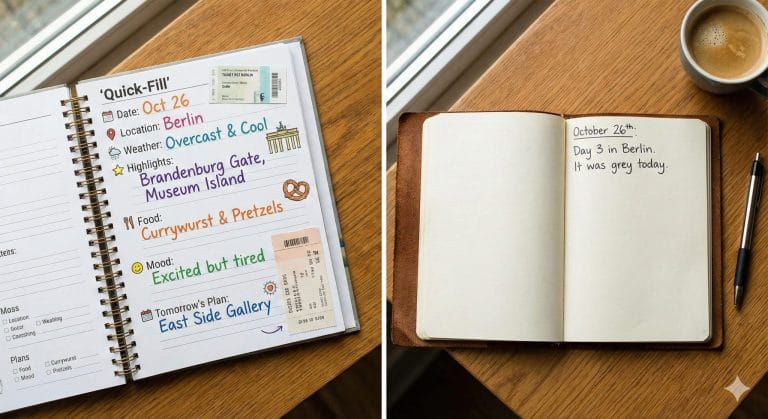
This is why adopting a structured, prompt-based journaling habit is so effective. The philosophy behind Quick-Fill Travel Journals is to take the heavy lifting out of documentation. Instead of staring at a blank page wondering how to format your daily spend, a quick-fill system provides dedicated, easy-to-use spaces for your logistics.
You can simply fill in the blanks: Total Spent Today, Best Value Purchase, Current Exchange Rate. By using a quick-fill methodology, tracking your daily budget takes seconds. It provides the financial accountability you need without draining the energy you want to save for tomorrow’s adventures.
Final Thoughts
Money is a tool that facilitates your travel; it should not be the dictator of your mood. It is completely normal to feel overwhelmed by foreign currencies, fluctuating exchange rates, and the occasional “tourist tax.”
By using your travel journal to logically track your exchange rates and emotionally process your budget anxieties, you regain control over your experience. You shift your mindset from “losing money to fees” to “investing money in a global education.”
Take a deep breath, write down the exchange rate, process the stress, and then close the journal. There is a whole world waiting for you outside the ATM line.
Want to simplify your travel documentation? Explore our collection of travel resources and journaling systems at The Explorer’s Nook. They are designed to help you capture your logistics, your budget, and your memories with ease, so you can focus on the journey ahead.


FAQ
The most reliable way to track a travel budget without a phone is by using a physical travel journal. Create a daily spending log and a “currency cheat sheet” that lists common conversion benchmarks (e.g., what $5, $10, and $50 equals in the local currency) so you can reference it quickly without doing mental math.
Currency exchange causes “math fatigue” and cognitive overload because travelers must constantly calculate conversions while navigating unfamiliar environments. Additionally, hidden fees and the fear of being scammed by money changers can trigger financial anxiety.
Use your travel journal to record functional data (daily exchange rates, ATM fees, and a daily spending tally) as well as emotional data. Write journal prompts to process the stress of unexpected expenses and to focus on the experiential value of your purchases rather than just the numeric cost.