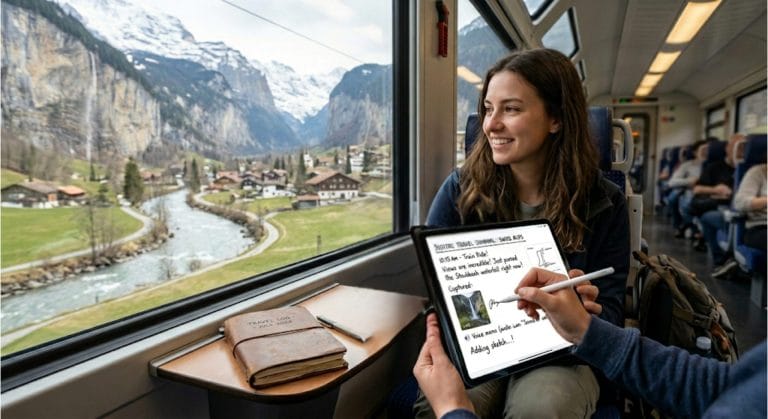

How to Log Travel Accommodations Like a Professional Explorer
We have all been there: you spend hours scrolling through filtered photos and reading glowing reviews for a “charming boutique stay,” only to arrive and find that the “high-speed Wi-Fi” is a single router shared between forty people and the “vibrant neighborhood” is code for a 24-hour construction site next door.
Public review platforms are helpful, but they are often skewed by the reviewer’s specific mood or a one-time experience. For the intentional traveler—the digital nomad, the overland adventurer, or the weekend explorer—your own travel journal is a far more reliable witness.
By creating a Structured Accommodation Log within your journal, you move beyond the vague “it was nice” and start building a database of what actually works for your lifestyle. Whether you are scouting locations for a future content shoot or simply trying to remember which hostel in Cape Town had the best pillows, a structured logging system is your best friend.
Why Your Journal is the Ultimate Review Tool
Travel journaling is frequently celebrated for its ability to capture the “soul” of a trip—the emotions, the scenery, and the personal growth. But the “bones” of a trip matter just as much. Where you sleep and work dictates your energy levels, your productivity, and your overall health.
When you document your stays in a structured way, you:
- Identify Patterns: You might realize you actually sleep better in eco-lodges than in five-star hotels.
- Save Your Future Self: You’ll know exactly which Airbnb host to book with again—or which one to avoid at all costs.
- Provide Better Recommendations: When a friend asks for a “quiet place with good internet,” you aren’t guessing. You have the data.
Learn more about our Quick-Fill Travel Journals for ANY Destination. Options for All Ages available.

The “Big Three” Metrics: Wi-Fi, Noise, and Comfort
To make your accommodation logs truly useful, you need to look past the decor and focus on the functional elements that impact your daily life.
1. The Connectivity Check (Wi-Fi & Power)
For those of us who manage digital projects or upload video content on the go, “bad Wi-Fi” isn’t just a nuisance—it’s a work stoppage.
- The Log: Don’t just write “Fast.” Write the actual speed (run a quick test at fast.com) and note the “drop-off” areas.
- Prompt: Is the signal strong in the bedroom, or only in the lobby? Are there enough power outlets near the desk/bed?
2. The Acoustic Audit (Noise Levels)
Noise is the silent killer of a good trip. A beautiful room is worthless if you can hear the elevator dinging all night.
- The Log: Track noise at three different times: Midday, Evening, and 2:00 AM.
- Prompt: Is the noise internal (thin walls, loud plumbing) or external (street traffic, roosters, nightlife)?
3. The Restoration Scale (Comfort & Climate)
Comfort is subjective, which is why your personal log is so important.
- The Log: Rate the “Bed Firmness” on a scale of 1-10 and the effectiveness of the climate control.
- Prompt: Does the AC/fan sound like a jet engine? Is the water pressure sufficient for a long-haul traveler?
Suggested Journal Layout: The Accommodation Grid
If you are setting up a blank page in your travel journal, try this structured grid. It’s designed to be filled out over the course of your stay, rather than all at once.
| Category | Rating (1-5) | Specific Notes |
| Wi-Fi Stability | ⭐⭐⭐ | Fast enough for email, too slow for video calls. |
| Sleep Quality | ⭐⭐⭐⭐ | Blackout curtains were great; mattress was firm. |
| Location/Safety | ⭐⭐⭐⭐⭐ | Walking distance to the market; secure gate. |
| Workspace | ⭐⭐ | Had to work from the dining table; chair was hard. |
| Vibe/Social | ⭐⭐⭐⭐ | Met three other solo travelers in the common area. |
The “Extra Mile” Section:
Leave space for the “Hidden Gems”—that one specific staff member who knew the best coffee spot, or the fact that the lodge offers a laundry service that isn’t advertised online.
Check out our range of Safari Quick-Fill Journals for All Ages with Animal Spotting Logs and other Safari features.

The Efficiency of the “Quick-Fill” Methodology
Let’s be realistic: after a ten-hour bus ride or a long day of filming, the last thing you want to do is draw a complex table or write a three-page essay on the ergonomics of your hotel chair. You are tired, you’re likely hungry, and you just want to decompress.
This is exactly where a Quick-Fill approach to journaling becomes a lifesaver. The philosophy behind a Quick-Fill Travel Journal is to remove the “friction” of documentation. By using pre-structured pages that already have prompts for things like Noise Level, Connectivity, and Comfort, you reduce the cognitive load. You aren’t “writing”; you are “logging.”
When the infrastructure of the page is already there—with checkboxes, star ratings, and short-form prompts—it takes less than two minutes to capture the essential data of your stay. It transforms journaling from a “creative project” into a “functional habit” that serves your travel goals.
Tailoring the Log to Your Stay Type
Not all accommodations are created equal, and your journal pages should reflect that.
For Hostels
Focus on the Security and Social aspects.
- How big are the lockers? Do they fit a laptop bag?
- Is there a “quiet hours” policy that is actually enforced?
- What is the kitchen-to-guest ratio?
For Airbnbs & Rentals
Focus on Utilities and Communication.
- How responsive was the host when the water heater went out?
- Is the kitchen actually “fully stocked,” or is there just one blunt knife and a cracked plate?
- Was the “Self Check-In” process a breeze or a scavenger hunt?
For Remote Lodges & Eco-Stays
Focus on Sustainability and Power.
- Is the power 24/7 or solar-limited?
- Are there mosquito nets, and are they actually hole-free?
- How accessible is the lodge from the main transport hubs?
Turning Data into Adventure
The beauty of a well-kept accommodation log is that it eventually becomes a guidebook written by you, for you.
Imagine planning a trip three years from now and being able to flip back through your journal to find that one specific lodge that had the perfect porch for writing, or the hostel with the lightning-fast Wi-Fi where you finished your biggest project.
Travel journaling is about more than just where you went; it’s about how you lived while you were there. By taking the time to log the logistics of your stay, you are honoring your needs as a traveler and ensuring that every future trip is built on the lessons of the past.
Want to spend less time formatting and more time exploring? Check out our collection of Quick-Fill Travel Journals at The Explorer’s Nook. They are designed with the modern traveler in mind—giving you the perfect structure to log your stays, your safety, and your memories without the stress of a blank page.


FAQ
The best way to rate a hotel is to use a 1-5 star scale across four categories: Wi-Fi/Connectivity, Noise Levels, Comfort/Bed Quality, and Value for Money. Use structured prompts to ensure you capture objective data.
Digital nomads should prioritize logging Wi-Fi upload/download speeds, the availability of dedicated workspaces, the ergonomic quality of chairs, and proximity to cafes or co-working spaces.
While digital tools are great for photos, a paper travel journal is more reliable for logistical logs as it doesn’t require battery or Wi-Fi. It also allows for quick “Quick-Fill” entries during transit or power outages.