
Travel Journaling Exercises for Decompressing After a Day of Sensory Overload
We travel to be amazed. We seek out the vibrant chaos of a West African market, the neon-drenched intersections of Tokyo, the labyrinthine alleys of Marrakech, and the cacophony of a Roman piazza. We want to taste new spices, hear unfamiliar languages, and lose ourselves in the rhythm of a foreign city.
But there is a fine line between being amazed and being completely overwhelmed.
By 4:00 PM on a heavy travel day, the vibrant chaos can suddenly feel like an assault on your nervous system. The heat feels sharper, the traffic sounds louder, and the simple act of figuring out where to eat dinner can bring you to the edge of tears.
This is travel-induced sensory overload. Your brain has spent the last eight hours processing millions of new data points—navigating unfamiliar transport systems, decoding foreign signs, and adapting to new cultural norms. Cognitive fatigue sets in, and your body’s natural response is a desperate need to shut down.
When you hit this wall, pushing through is the worst thing you can do. Instead, you need a decompression chamber. And the most accessible, effective tool for grounding your nervous system fits right in your daypack: your travel journal.
Here are simple, highly effective journaling exercises designed specifically to help you process the noise, calm your mind, and recover from travel overwhelm.
Learn more about our Quick-Fill Travel Journals for ANY Destination. Options for All Ages available.

Why Journaling Calms the Nervous System
When we experience sensory overload, our brains are stuck in a loop of “too much information.” We lose our ability to prioritize thoughts, leading to a feeling of panic or deep exhaustion.
Opening a physical notebook acts as a circuit breaker. The tactile sensation of paper and pen brings you out of the chaotic environment and into a controlled, defined space. Writing forces your brain to slow down to the speed of your hand, organizing the jumbled, racing thoughts into a linear, manageable format. It signals to your nervous system that the immediate “threat” of the environment has passed and it is safe to rest.
Exercise 1: The “Brain Dump” Release
When you first retreat to your accommodation (or a quiet café), your mind is likely buzzing with a mix of leftover anxiety, logistical worries, and fragmented memories. Do not try to write a poetic summary of your day. Just get the noise out.
- The Exercise: Set a timer for three minutes. Write down every single thing crowding your mind in bullet points. Do not worry about grammar or complete sentences.
- Examples:
- The scooter that almost hit me.
- I need to find an ATM tomorrow.
- It is so hot my shoes feel heavy.
- Did I overpay for that taxi?
- The smell of that roasted street food.
- Why it works: By transferring these thoughts from your active memory onto paper, you literally lighten your cognitive load. You are telling your brain, “I have captured this information; you can stop carrying it now.”
Exercise 2: The “Sensory Sieve” (The 3-2-1 Method)
Sensory overload happens when you take in too much at once. The “Sensory Sieve” exercise reverses the process by forcing you to isolate and appreciate individual details, turning chaos into calm observation.
- The Exercise: Take a deep breath and look around your current, quiet environment (your hotel room, a quiet park, or a silent lobby). Write down:
- 3 things you can see right now (e.g., the pattern on the curtains, my dusty boots, the blue sky out the window).
- 2 things you can physically feel (e.g., the cool air from the AC, the weight of the pen in my hand).
- 1 thing you can hear (e.g., the low hum of the refrigerator).
- Why it works: This is a classic anxiety-grounding technique adapted for your travel journal. It pulls you out of the overwhelm of the crowded streets and anchors you firmly in the safety of the present moment.
Exercise 3: The “One Good Thing” Reframe
When we are exhausted, our brains have a negativity bias. We tend to focus on the missed train, the rude waiter, or the blistering heat, completely forgetting the beautiful moments that happened earlier in the day.
- The Exercise: Answer this single prompt: Despite the exhaustion, what was the one moment today that made this entire trip worth it?
- Why it works: You aren’t invalidating your stress; you are simply ensuring it doesn’t hijack your entire memory of the destination. Focusing on a single, positive interaction—a shared laugh with a vendor, the perfect cup of coffee, a brief moment of shade under a beautiful tree—restores your sense of gratitude and purpose.
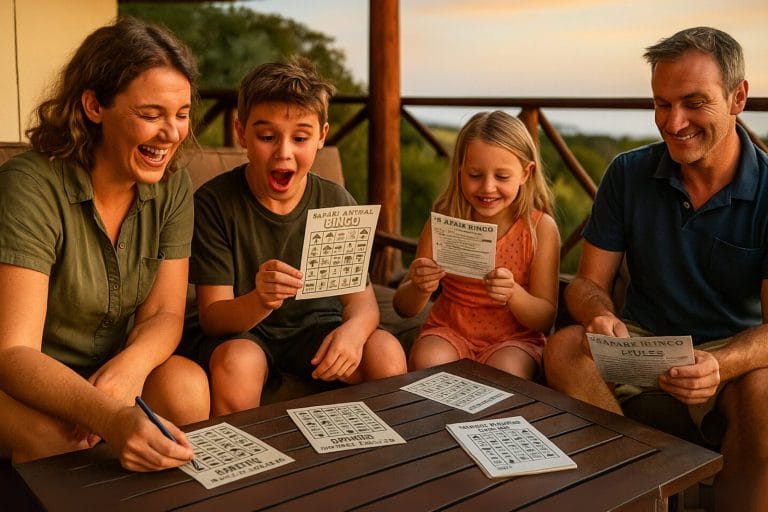
Check out our range of Safari Quick-Fill Journals for All Ages with Animal Spotting Logs and other Safari features.

The “Quick-Fill” Philosophy for Exhausted Travelers
If you are reading these exercises and thinking, “I am way too tired to write paragraphs when I’m overwhelmed,” you are not alone. In fact, staring at a blank, white page can sometimes trigger more anxiety when your brain is already fried.
This is where the Quick-Fill approach to travel journaling becomes an absolute lifesaver.
When you are tapped out, you don’t need a blank canvas; you need a blueprint. This is the guiding principle behind our Quick-Fill Travel Journals. Instead of asking you to conjure up a narrative from scratch, these journals provide pre-formatted spaces, checkboxes, and short prompts.
You can log your mood, tally your highlights, and rate your day in under sixty seconds. The structure is already built for you. By removing the “friction” of deciding how and what to write, a quick-fill system allows you to reap the calming, grounding benefits of journaling without spending any of your precious, depleted energy. It is documentation designed for the reality of travel fatigue.
Exercise 4: The “Tomorrow’s Anchor” Plan
A major component of travel overwhelm is dreading the logistics of the next day. Before you close your journal and go to sleep, set a tiny, manageable anchor for the morning.
- The Exercise: Write down ONE incredibly simple goal for tomorrow morning.
- Tomorrow, my only goal before 10:00 AM is to find a bakery and drink water.
- Tomorrow, I am sleeping in and not looking at a map until noon.
- Why it works: Decision fatigue is a primary driver of sensory overload. By making your first decision for tomorrow tonight, you give yourself permission to wake up without panic. You already know exactly what the first step is.
Final Thoughts: Give Yourself Permission to Pause
Travel culture often glorifies the “hustle”—the idea that you must maximize every waking second to get your money’s worth out of a trip. But a destination is not a checklist.
If you spend an entire afternoon sitting in your rental room, drinking cold water, and scribbling in your travel journal while the city moves without you outside, you have not “wasted” a day. You have successfully managed your limits.
The next time the noise gets too loud, step away. Find a quiet corner, open your journal, and let the pen do the heavy lifting. The world will still be there, waiting for you, when you are ready to explore it again.
Looking for a way to capture your journey without adding to your mental load? Explore our collection of travel resources and Quick-Fill Travel Journals at The Explorer’s Nook—designed to bring structure, ease, and mindfulness to your greatest adventures.


FAQ
Travel sensory overload occurs when the brain receives more information than it can process from a new environment. Unfamiliar languages, extreme weather, chaotic traffic, and constant navigation create cognitive fatigue, leading to feelings of anxiety, irritability, and exhaustion.
Journaling helps manage travel anxiety by acting as a grounding tool. Writing slows down racing thoughts, externalizes logistical worries, and helps shift the brain’s focus from environmental chaos to the controlled, physical act of putting pen to paper.
When exhausted, avoid long-form writing. Use a “Brain Dump” to quickly list your worries in bullet points, or use a “Quick-Fill” journaling method to simply check boxes for your mood, log the weather, and write down one positive memory from the day.