
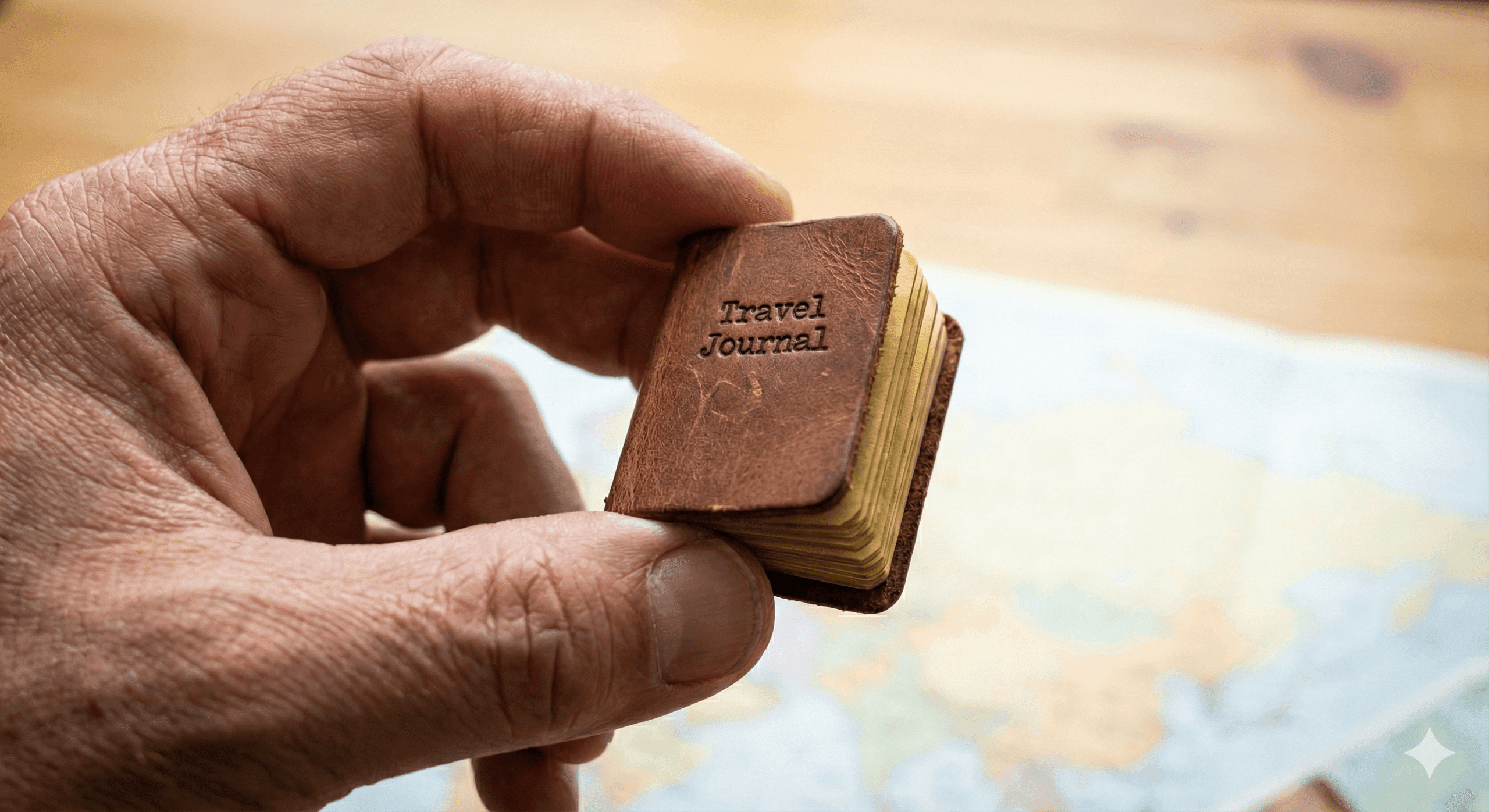
Minimalist Travel Journaling: How to Journal Light and Smart
As a traveler committed to minimalism, every item in your backpack must justify its weight and space. The idea of lugging heavy notebooks, multiple pens, and elaborate scrapbooking supplies can feel overwhelming and counterproductive to your light-and-free lifestyle.
But minimalist travel doesn’t mean sacrificing the rich, reflective practice of journaling. It means being intentional and strategic about what you carry and, more importantly, how you document.
If you’re looking for ultralight journaling hacks, efficient memory-keeping methods, and the best travel journal setup for minimalists, here is the definitive guide to maintaining a powerful journal practice while keeping your pack weight low.
Learn more about our Quick-Fill Travel Journals for ANY Destination. Options for All Ages available.

1. ⚖️ The Minimalist Gear Kit: One Pen, One Notebook
The easiest way to be a minimalist journaler is to drastically reduce your supplies. Every extra item adds friction and weight.
- The Journal: Choose a single, A6 (Pocket Size) or Passport-Sized notebook, ideally a softcover or a Traveler’s Notebook with just one thin insert. A slim, 100-page journal is perfect for a 3-4 week trip.
- The Pen: Limit yourself to one great pen. A high-quality black fineliner or a durable fountain pen with a large ink capacity (like a TWSBI Eco) is ideal. If you must have color, choose a dual-tipped highlighter (like a Mildliner) that offers two colors in one stick.
- The Adhesive: Swap the messy glue stick for a small, dry adhesive roller (tape runner) or a tiny roll of Washi Tape. These are lightweight and eliminate the risk of sticky explosions in your bag.
- The Pouch: Consolidate all supplies into one ultra-flat, zippered mesh pouch (a small Muji or EVA case) that fits snugly in a backpack pocket.
2. 📝 The “Capture Now, Elaborate Later” Writing Method
Minimalist journaling is about low-friction capture. Don’t feel pressured to write a novel every night.
- Micro-Journaling: Dedicate just 3-5 minutes each day to a “Flash Entry.” Use bullet points, not paragraphs.
- The Vitals: Location, Date, Weather Icon.
- The Stats: Total steps, miles hiked/driven, total daily budget spent.
- The Highlights: One favorite quote, one unexpected sight, one distinct smell.
- The Hybrid Method: Use your phone’s Notes app or Voice Memo throughout the day to quickly log keywords, feelings, or funny anecdotes. This captures the raw data in the moment without stopping your adventure. Then, transfer only the most meaningful points to your physical journal later that evening.
- The After-Trip Mega-Entry: Save the long, reflective prose for when you return home. Use your minimalist notes and photos as your comprehensive outline to write a full, thoughtful summary of the trip’s emotional arc.


3. ✂️ Minimalist Ephemera: Quality Over Quantity
Minimalist does not mean souvenir-free! It means being highly selective about the tangible items you save.
- The Flat Rule: Only save items that are genuinely flat and non-bulky:
- Ticket stubs (plane, train, museum).
- Small, unique receipts (from that one incredible cafe).
- Coasters or small paper napkins with a distinctive logo.
- The Cutting Board: Don’t paste in the entire massive tourist brochure. Tear out only the map or the one paragraph of text that is truly relevant to your entry. This drastically reduces the bulk.
- The Photograph: Rely on digital photos to document most visual memories. Only print (or have printed) one significant, high-impact photo per week to paste into your journal. Use a small, $2 \text{ in} \times 3 \text{ in}$ size to conserve space.
4. 💻 Leveraging Digital Tools for Analog Clarity
A true minimalist leverages technology to keep the physical space clean and light.
- Digital Back-Up: Use a smartphone app (like Adobe Scan or a simple camera app) to take quick, clear photos of your completed journal pages. This creates a secure, searchable, and lightweight digital archive of your handwritten memories.
- Pre-Trip Templates: Use your digital journal system (e.g., a PDF template) to design and print out only the essential pages you need: a packing list, a budget tracker, and a few dot-grid daily logs. Put these in a small folder instead of carrying a full notebook.
- Location Tagging: Use a free app like Google Maps Timeline to automatically track your route and location names. This means you don’t have to manually write down every address and time stamp, freeing your journal space for personal reflection instead of data logging.
Minimalist travel journaling proves that the most valuable memories are not measured by the thickness of the book or the volume of supplies, but by the depth and intentionality of the entries. Keep it simple, keep it smart, and keep moving!
Check out our Quick-Fill Travel Journals on Etsy:


Quick-FIll Travel Journal for ANY Destination
The travel journal for explorers who want to remember everything, but would rather be living the adventure than staring at a blank page.


