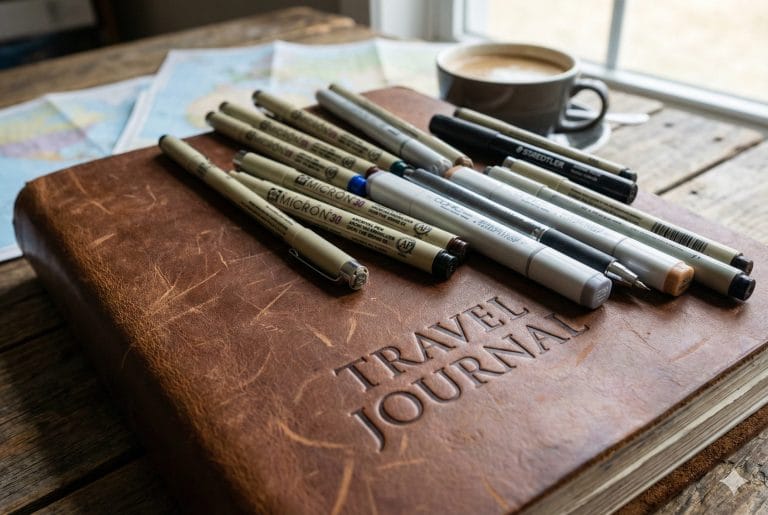

What to Look for in a Good Travel Journal (Cover, Paper, Prompts, and Size)
Your travel journal is more than just a notebook—it’s the home for your memories, the keeper of your reflections, and the trusty sidekick to your adventures. Choosing the right one is crucial, as the wrong features can quickly turn journaling from a joy into a chore.
This guide will help you find the perfect balance of durability, portability, and functionality in your memory book. Forget buyer’s remorse; this guide breaks down the four most critical elements to consider before you invest in your next travel journal.
1. 🛡️ Cover and Binding: The Durability Test
Your journal will face the elements: hostel backpacks, spilled coffee, sand, and humidity. Its exterior needs to be a fortress.
| Feature | What to Look For | Why It Matters for Travel |
| Cover Material | Water-resistant materials like vegan leather, thick canvas, or treated polyurethane. | Durability. Protects pages from spills, dirt, and wear and tear in your bag. |
| Cover Style | Hardcover (maximum protection) or Refillable Softcover (minimal weight, maximum customization). | Writing Surface. A hardcover provides a firm surface for writing anywhere (on a train, on your lap). |
| Binding | Section-Sewn / Thread-Bound or Concealed Spiral. | Lay-Flat Ability. A journal that opens completely flat ($180^{\circ}$) prevents hand cramps and lets you use the entire page margin-to-margin. |
| Closure | An Elastic Band or a Magnetic Flap/Wrap closure. | Security. Keeps the pages and any loose mementos (tickets, receipts) tucked safely inside. |


2. 📝 Paper Quality & Layout: The Writing Experience
Paper quality is the unsung hero of a great journal. Poor paper can lead to ink bleed, turning your beautiful entries into a messy frustration.
Paper Weight (GSM)
- Ideal Range: Aim for paper that is 80 g/m² (grams per square meter) or higher.
- The Problem with Low GSM: Anything lower than $80 \text{ g/m}^2$ is likely to suffer from “ghosting” (the outline of the ink showing through on the opposite side) or “bleeding” (ink soaking right through the paper), especially if you use fountain pens or markers.
- Key Descriptor: Look for journals labeled “Acid-Free” to ensure the pages won’t yellow or crumble over decades, preserving your memories.
Page Layout
| Layout Type | Best For | Why Choose It |
| Lined/Ruled | Traditional prose, lengthy daily entries, and neat note-taking. | Keeps your writing straight and organized if you are a detailed writer. |
| Dot Grid | Versatility, visual journaling, and bullet journaling style. | Offers enough structure to write straight but is light enough to ignore for sketching, charts, or pasting mementos. |
| Blank | Sketching, painting, creative expression, and heavy scrapbooking. | Pure freedom for those who prioritize visual art over text. |
3. 📏 Size and Portability: The Travel-Friendly Factor
As an avid traveler, you need a journal that fits your lifestyle. Size directly impacts your willingness to carry and use the journal daily.
- The Sweet Spot (Mid-Size): Most travelers find the A5 (approx. $5.8 \text{ in} \times 8.3 \text{ in}$) or a slightly smaller Midi size ($5 \text{ in} \times 7 \text{ in}$) to be the perfect balance. It’s large enough to write comfortably but small enough to tuck into a day bag or backpack pocket.
- The Minimalist (Pocket Size): If you are a strict backpacker where every ounce counts, look for A6 (approx. $4.1 \text{ in} \times 5.8 \text{ in}$) or “Passport” size. These are best for quick notes, quotes, and expense tracking.
- The Page Count Fallacy: Don’t buy a 500-page behemoth! It’s heavy and intimidating. A $150 \text{-to-} 200 \text{-page}$ journal is usually plenty for a multi-week trip and gives you the satisfaction of filling a complete book.
Check out our Quick-Fill Travel Journals on Etsy:


Quick-FIll Travel Journal for ANY Destination
The travel journal for explorers who want to remember everything, but would rather be living the adventure than staring at a blank page.

4. ✨ Prompts and Features: Enhancing the Experience
Finally, consider the structural elements that make a journal feel like a dedicated travel tool, not just a blank book.
- Pre-Printed Prompts: Ideal for beginners or those who struggle with “writer’s block.” Look for journals with light prompts like “The Best Thing I Tasted Today,” or “A Conversation I Overheard.” These ensure you capture memorable details without effort.
- Gusseted Pocket: An accordion-style pocket built into the back cover is essential. This is the secure storage area for receipts, ticket stubs, business cards, and other small, precious flat souvenirs.
- Integrated Tools: Look for a journal that includes a ribbon bookmark (or two!) and a pen loop. These small additions simplify the daily use and keep your essential tools secured.
By focusing on these four key areas, you can confidently select a travel journal that will not only survive your adventures but will become a cherished, usable artifact of your time on the road.